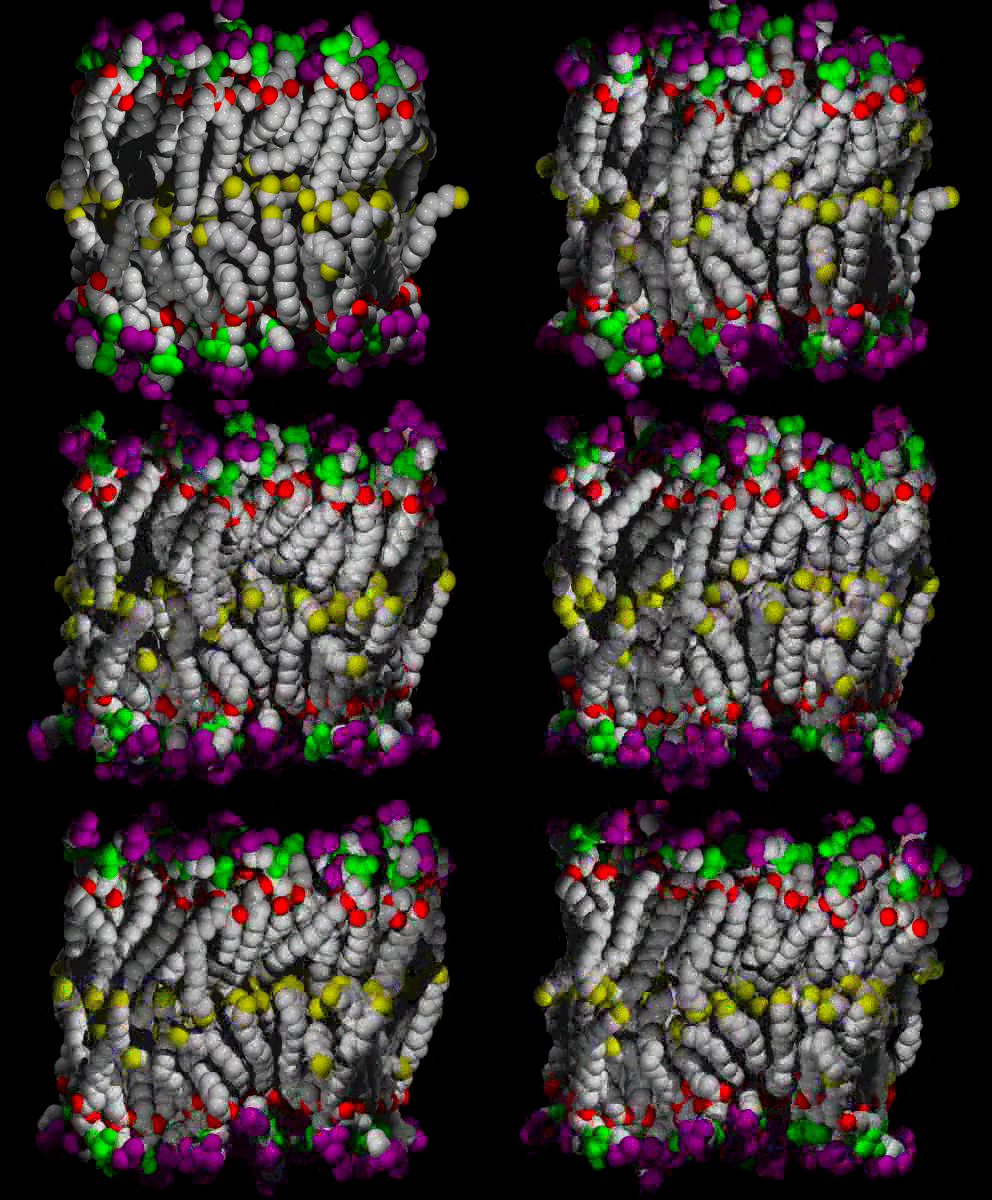
As a Master of Science student in Dr. Lloyd Elliott's lab I am studying computational biology from a few directions. Below, I briefly describe these directions and present some entertaining materials from my studies.
Memberships
Master's Thesis
My primary research is in genomics and metabolomics with the objective of increasing the collective understanding of the aging process in humans. Our lab explores statistical methods to learn about biological processes that influence longevity using the Canadian Longitudinal Study on Aging and an exceptional cohort of Super-Seniors (conducted by my co-supervisor Dr. Angela Brooks-Wilson).
I am particularly interested in networks of metabolites, and how to learn about them to discover clinically relevant insights. Methods for learning metabolite networks include sparse or other specialized estimation methods for the covariance, correlation and partial correlation matrices. I am interested in these methods and their applications to graphical models and network science.
Phylogenetics
To complement my studies in human health, I am collaborating with Dr. Arne Mooers and Dr. Jonathan Davies to study methods for modeling time series of species abundance and how relationships between species can help us estimate change in global biodiversity.
Statistical Collaboration
In addition to the research areas listed above, I am keen to collaborate in other topics. Most recently, I worked with my close friend Dr. Eric MacFadden to design, conduct experiments and analyze data for his study on computer assisted implant surgery. This work was selected to be presented by Dr. MacFadden at the 2026 Ramfjord Symposium and has now been published (linked below).
Publications
- MacFadden, E. C., Sobczak, C. M., & Guentsch, A. (2026). Impact of Level of Guidance on the Accuracy of Static Computer‐Assisted Implant Surgery (s‐CAIS): An In Vitro Study. Clinical Oral Implants Research. https://doi.org/10.1111/clr.70179